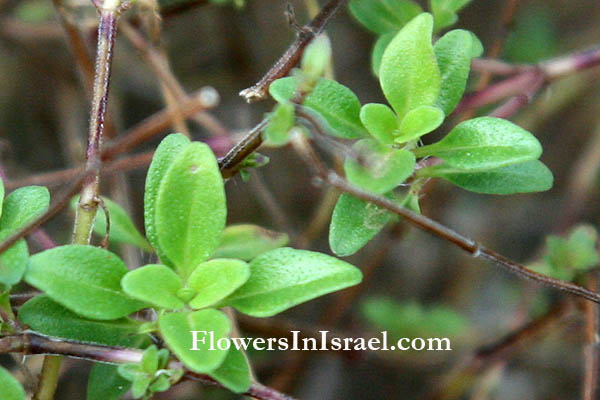
Thymus vulgaris, Common Thyme, Garden Thyme,
Hebrew: בת קורנית פשוטה ,טימין, Arabic: الزعتر الشائع
|
|
| Scientific name: |
| Thymus vulgaris L. |
| Common name: |
| Common Thyme, Garden Thyme |
| Hebrew name: |
| בת קורנית פשוטה ,טימין |
| Arabic name: |
| الزعتر الشائع |
| Plant Family: |
| Labiatae / Lamiaceae, שפתניים |
|
|
| Life form: |
| Chamaephyte |
| Leaves: |
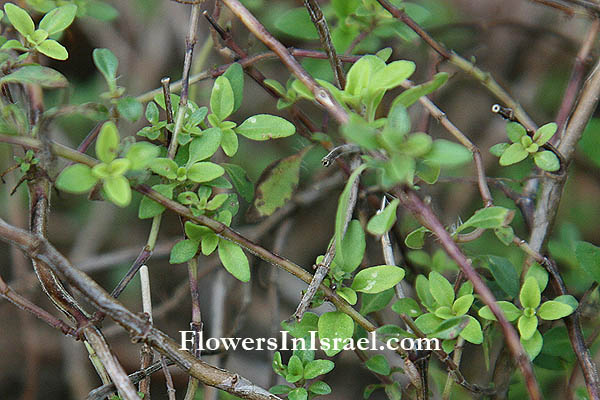
| Opposite, entire, oval, 4-20mm long |
| Flowers: |
| In dense terminal heads, with an uneven calyx, with the upper lip three-lobed, and the lower cleft; the corolla is tubular, 4-10 mm long, and white, pink or purple. |
| Flowering Period: |
| May, June, July, August, September, October |
| Chorotype: |
| Mediterranean |
| Summer shedding: |
| Perennating |
Derivation of the botanical name:
Thymus, the ancient Greek name for these aromatic herbs and subshrubs.
vulgaris, common.
The Hebrew name: קורנית, koranit, perhaps from koren (keren)+ suffix. It is also mentioned in the Talmud (seventh 8a).
- The standard author abbreviation L. is used to indicate Carl Linnaeus (1707 – 1778), a Swedish botanist, physician, and zoologist, the father of modern taxonomy.
Thymus vulgaris is a commonly used culinary herb and a basic ingredient in French, Greek, Italian, Lebanese, Persian, Portuguese, Spanish, Syrian, and Turkish cuisines.
It is a component in the bouquet garni, which may also include basil, burnet, chervil, rosemary, peppercorns, savory and tarragon, and an important element in Herbes de Provence (Provençal herbs).
The essential oil of Thymus vulgaris is made up of 20-55% thymol, an antiseptic. Thymol is an important ingredient of toothpastes, mouthwashes (Listerine), and contemporary antirheumatic medicines.
Pliny (23–79) refers to Thymus vulgaris used to treat headaches and intestinal complaints. He knew Thyme as a medicine, advising melancoly people to stuff their "crying pillows" with Thyme.
John Gerard (1545-1612), an English botanist, writes about thymus:"It bringeth downe the desired sickness, provoketh urine and applied in bathes it procureth sweat; being boyled in wine it helpeth the ague, stayeth the hicket, breaketh the stones in the bladder; it helpeth lethargie, frensie and madness and stayeth the vomiting of bloud...is good against the wambling and gripings of the bellie, ruptures, convulsions and inflammation of the liver."
Nicholas Culpeper (1616-1654), the English herbalist, recommends Thymus as "It is a notable strengthener of the lungs, as notable a one as grows: nor is there a better remedy growing for hooping-cough. It purgeth the body of phlegm, and is an excellent remedy for shortness of breath."
Carl Linnaeus (1707-1778), the Swedish botanist, physician and zoologist, used Thymus to treat headaches and hangovers.
|