Spotted Spurge, Chamaesyce maculata,
Hebrew: חלבלוב נטוי, Arabic: الفربيون المموج
| Scientific name: | Euphorbia maculata L. | |
| Synonym name: | Euphorbia nutans Lag. | |
| Common name: | Spotted Spurge, Chamaesyce maculata | |
| Hebrew name: | חלבלוב נטוי | |
| Arabic name: | الفربيون المموج | |
| Plant Family: | Euphorbiaceae, חלבלוביים |
|
| Life form: | Annual | |
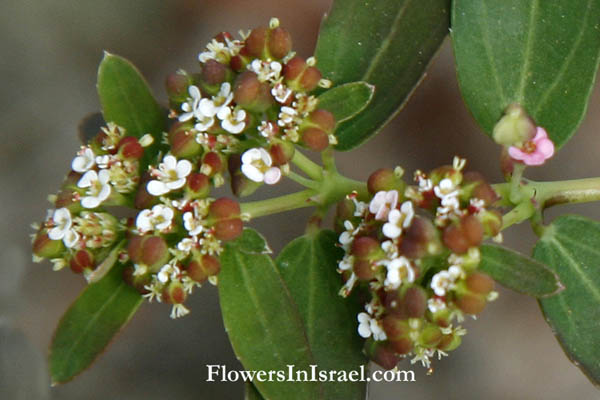
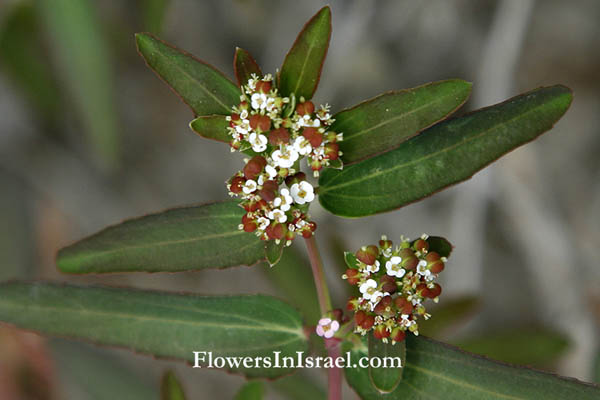
| Stems: | Up to 45cm long, 30cm tall, herbaceous, erect to ascending or reclining, branching, sparse pubescent, with milky sap, typically becoming red in strong sun | |
| Leaves: | Opposite, entire, dentate or serrate | |
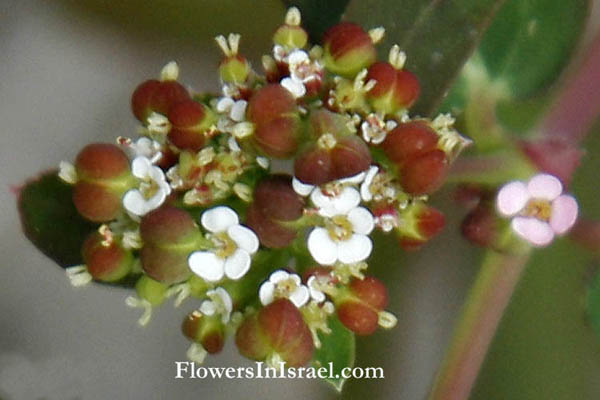
| Inflorescence: | Single axillary cyathia | |
| Flowers: | Green; white petaloid appendage and greenish gland extending from the rim of cyathium; ovary of the female flower covered with hairs | |
| Fruits / pods: | Capsule 3-sided, 3-locular, glabrous; one seed per locule | |
| Flowering Period: | August, September | |
| Habitat: | Cultivared weeds | |
| Distribution: | Mediterranean Woodlands and Shrublands, Shrub-steppes | |
| Chorotype: | American | |
| Summer shedding: | Ephemeral |
Derivation of the botanical name: Euphorbia, Εὔφορβος, Euphorbus, after the Numidian physician Euphorbus, physician to Juba II, King of Numidia and Mauretania, about the end of the first century BCE. In classical Greek ευφορβοσ (euphorbos) means well fed. maculata, maculo, to spot, stain, pollute, defile; spotted. nutans, nodding. Chamaesyce, Greek, chamai, on the ground, lowly, creeping; sykon, "fig" (an oblique reference to the shape of the capsules).
|