Hebrew: לוע-ארי קטן, Arabic: سيسم نهر العاصي, Egypt: سيسام "Saysam"
| Scientific name: | Antirrhinum orontium L. | |
| Synonym name: | Misopates orontium L. ׂ | |
| Common name: | Small Snapdragon | |
| Hebrew name: | לועית קטנה,לוע-ארי קטן | |
| Arabic name: | سيسم نهر العاصي | |
| Egypt: | سيسام "Saysam" | |
| Family: | Scrophulariaceae, לועניתיים |
|
| Life form: | Annual | |
| Stems: | Up to 60cm high; simple or branched, erect, hairy-stemmed | |
| Leaves: | Sessile to short-petioled, opposite below, alternate above, linear to narrow-lanceolate | |
| Inflorescence: | Lax racemes, short-pedicelled | |
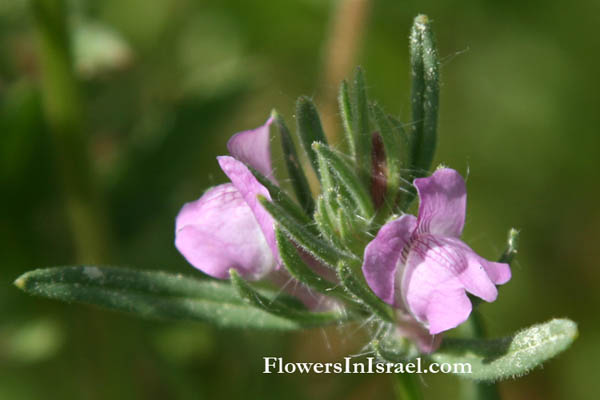
| Flowers: | Calyx pilose; calyx lobes unequal, narrowly-linear; corolla pink | |
| Fruits / pods: | Capsules very hairy; seeds numerous, reticulate-rugose | |
| Flowering Period: | January, February, March, April, May | |
| Habitat: | Batha, Phrygana | |
| Distribution: | Mediterranean Woodlands and Shrublands, Semi-steppe shrublands, Shrub-steppes, Deserts and extreme deserts | |
| Chorotype: | Mediterranean | |
| Summer shedding: | Ephemeral |
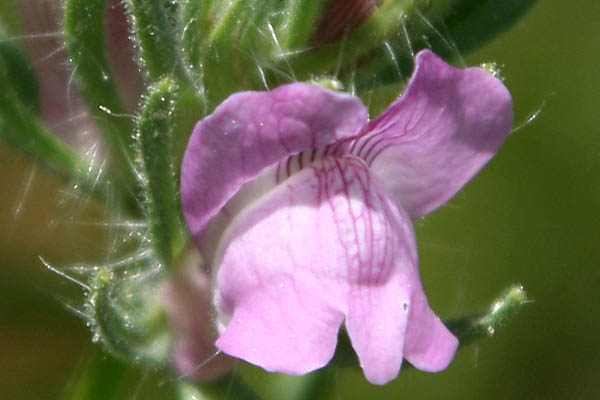
Derivation of the botanical name: Antirrhinum, from Greek anti (αντι), "like," and rhis (ριϛ, ινοϛ), "nose", inus (-ινοϛ), probably referring to the nose-like capsule in its mature state. orontium seems to be derived from Latin oro, "to speak", "to plea", "to beg", which may have something to do with the mouth-like form of the flower. Misopates, according to Corneliuson (1997) is derived from Greek misos, "to hate" and patein, "to step on", (the author of the name seems to hate to step on that beautiful little plant). The Romans called it leonis ora, or “lion’s mouth.” The Old French word for Snapdragon was muflier, or “snout”; the Italians called the flower bocca de leone, and the Germans Löwenmäul, which both mean “lion’s mouth.” The Hebrew word: לוע-ארי, loah-arie, “lion’s mouth.”
|